

While “wealth buys freedom”, some of the most fiercely free people I have known do not have or care for money. In this piece I want to explore why that is, through the idea of freedom as functional optionality.
Throughout history, people have come up with many ideas of what freedom is, and some have questioned whether freedom is even technically possible. Perhaps we are just automatons without free will. That is a potentially impossible question to answer, and I will bypass it in this article. Instead I want to build my argument on our ordinary experience of freedom. Whether that experience is real or merely perceived, we seem to have at least some ability to make choices, and so we perceive ourselves as having free will. That is the freedom this article is concerned with.
What optionality is
Optionality is essentially this: given a certain state of affairs, we have a certain number of options available to us. If you don’t have a passport, your travel is restricted. Having a passport offers optionality.
As far as I know, the term was really popularized by Nassim Taleb in his book Antifragile, where he traces how optionality was one of the essential ingredients of his own investment strategy, and then extrapolates it into a broader code: one should design one’s life around optionality.1 Taleb adds a caveat that matters for everything that follows: an option only has value if you are willing to exercise it. Hoarding options you never use is not freedom, it is indecision with better branding.
I think this is a great idea. In fact, I think that thinking of freedom as simply having optionality available at a given moment is a good way, perhaps the best way, to think about it. But there have been other ways of considering freedom throughout history, and so I want to make a few quick side stops first.
Side stop one: freedom from debt
The oldest notion of freedom we can find is freedom from debt. In David Graeber’s book Debt there is a great exploration of the origins of debt and money, and it turns out that the word freedom has its roots in being free of debt. Quite literally: the earliest recorded word for “freedom” in any human language is the Sumerian ama(r)-gi, found on the Cone of Urukagina, a ruler of Lagash around 2350 BCE. It means “return to the mother,” and it described a royal decree that cancelled outstanding debts, returned land to its original owners and released debt-bondsmen to go home to their families. Freedom, in its first written form, meant a clean slate.2
Debt has been around for as long as we have written records, and is not, contrary to popular notion, a recent invention. Credit came before coins. And back then, debt was entangled with all sorts of suffering. If you were unable to pay off your debts, not just your resources or land could be confiscated, but your very family members, and in some cases your own freedom. The Code of Hammurabi stipulates that a man who cannot pay may hand over his wife, son or daughter to work off the debt for three years. Babylonian kings issued some thirty general debt cancellations between roughly 2400 and 1400 BCE, typically on taking the throne. The Hebrew Bible institutionalized the practice in the Jubilee, a fiftieth year in which debts were forgiven and bondsmen freed. In Athens, Solon’s seisachtheia, the “shaking off of burdens” of 594 BCE, abolished debt slavery outright after farmers had been losing land and family members to creditors.3
Graeber adds an echo in our own language: the English word “free” derives from a Germanic root meaning “friend,” because a slave, unable to make binding promises, could not have friends in the full sense. To be free was to be able to commit.
Side stop two: freedom from heavy taxation
A second notion of freedom is freedom from heavy taxation. Being Belgian, my favorite example comes from the Low Countries. In 1569 the Duke of Alba, governing on behalf of the Spanish crown, tried to impose a permanent ten percent sales tax on every transaction of movable goods, the “Tenth Penny,” on top of a one-off levy on capital and real estate. The provinces had always granted their taxes by consent, one request at a time; a permanent tax, decided in Brussels and collected without their say, was a different animal. When Alba tried to enforce it in 1571, merchants in Brussels shut their shops, towns refused to collect, and the Tenth Penny became one of the grievances that turned a simmering religious conflict into the Dutch Revolt. Alba withdrew it in 1572. The tax itself was never really collected; the fight was over who got to decide.4
Integral to that idea of freedom is the limitation of taxation, so that the individual keeps more of his prosperity to enjoy in his own pursuits.
Crude measures
It is easy to see why people associate freedom with their financial situation; both historic examples show it. But these are crude measures, since our notion of heavy taxation seems to depend heavily on where and when we live. Imagine a New Yorker of 1776, who paid no income tax at all and carried roughly a thirtieth of the tax burden of a Londoner, stepping into the New York of today and finding out that a successful Manhattanite can lose roughly half of every additional dollar earned, between federal, state and city taxes. We can only imagine the horror.5
Debt, too, has evolved, and perhaps one’s balance sheet is a better measure of freedom in that sense. But both of these, taxation and debt, are ultimately components of optionality.
Why optionality is the better measure
The reason I think it is better to think in terms of optionality is this: if we really sense that freedom has something to do with decisions, then optionality is the most direct measure of it. There are cases where someone has a lot of wealth, low taxes and no debt, and is still limited in optionality. Some of the most fiercely free people I have known have been poor. They have been extremely creative in how they handle life and, in equally resourceful ways, in how they find joy in it. One friend of mine is fond of making extraordinarily fun and creative drawings on plain printer paper with markers, and often when he has friends over, they join him and draw together. It is somehow not an activity I have spotted as often amongst my more affluent friends. Yet I regard this kind of creativity as a high measure of freedom, in the optionality sense.
Philosophers have a name for the distinction I am circling. Isaiah Berlin separated “negative liberty,” freedom from interference, which is what both of my side stops describe, from “positive liberty,” the real capacity to act. Amartya Sen went a step further and defined development itself as the expansion of people’s capabilities, the real freedoms to do and be what they have reason to value, arguing that income is only a crude proxy for them. Functional optionality is, more or less, Sen’s capabilities in a founder’s vocabulary.6
I am not, however, advocating for poverty. In fact, I think the single greatest reason to pursue wealth is to increase one’s optionality. The ability to go wherever, whenever one pleases is a great joy in life worth striving for. Money can buy health and experiences, and it can help extend our lives. All of these things increase optionality tremendously. This, I think, is the most important reason to pursue wealth.
Ironically, in the pursuit of wealth we have to recognize that optionality might, seemingly, be severely decreased. Personally, while I built my company DESelect, I worked very long days for many years, spending all my waking hours on the business. My “free time” would be spent quickly eating a meal or getting a workout in to stay healthy, which in many ways was still in service of the business. And I would, of course, work through the weekends as well. From the outside, it might seem that my optionality was reduced. But even at that time, my optionality increased in interesting ways. Doors opened that had not only been closed to me before; I simply hadn’t known they existed. People I had looked up to as a fledgling entrepreneur became mentors, sometimes even peers. Networks opened up.7 And then there were the more straightforward things, like being able to fly business class and enjoy the comfort whenever I took a plane for work.
Freedom in responsibility
This brings me to perhaps the most counterintuitive statement of this piece: there is freedom in responsibility. The reader, now understanding the importance I attach to optionality, can probably draw her own conclusions. Essentially, when people take up more responsibility, they may be limiting themselves in certain aspects. Someone who has a child is now committed to raising that child for approximately twenty years, will be more financially constrained, and will lose a lot of sleep, especially in the first few years. But at the same time, a whole world of optionality opens up through the joy of parenthood: the pride, the richness of emotional connection, and the quieter, more serious side of life that seems to come with parenthood as well.
History offers the same lesson at the scale of nations. The American colonists of the 1770s were, by the numbers, among the least taxed people in the Western world. What they rebelled against was not the size of the bill but the fact that they had no seat in the body that wrote it. “No taxation without representation” is not a demand for lower taxes; it is a demand to carry the responsibility of deciding them. Having won that responsibility, the new states promptly tripled their own tax burden to pay for the war. They had less money and were, by their own account, more free.
Viktor Frankl made the point more bluntly. Freedom, he wrote, is only half the story; the other half is responsibility, and he suggested that the Statue of Liberty on the East Coast be complemented by a Statue of Responsibility on the West Coast.8 Chess players know a version of it too: a pawn that is never moved has every square theoretically open, while a piece that commits to the centre is the one that controls the board. Commitment reduces hypothetical options and multiplies real ones.
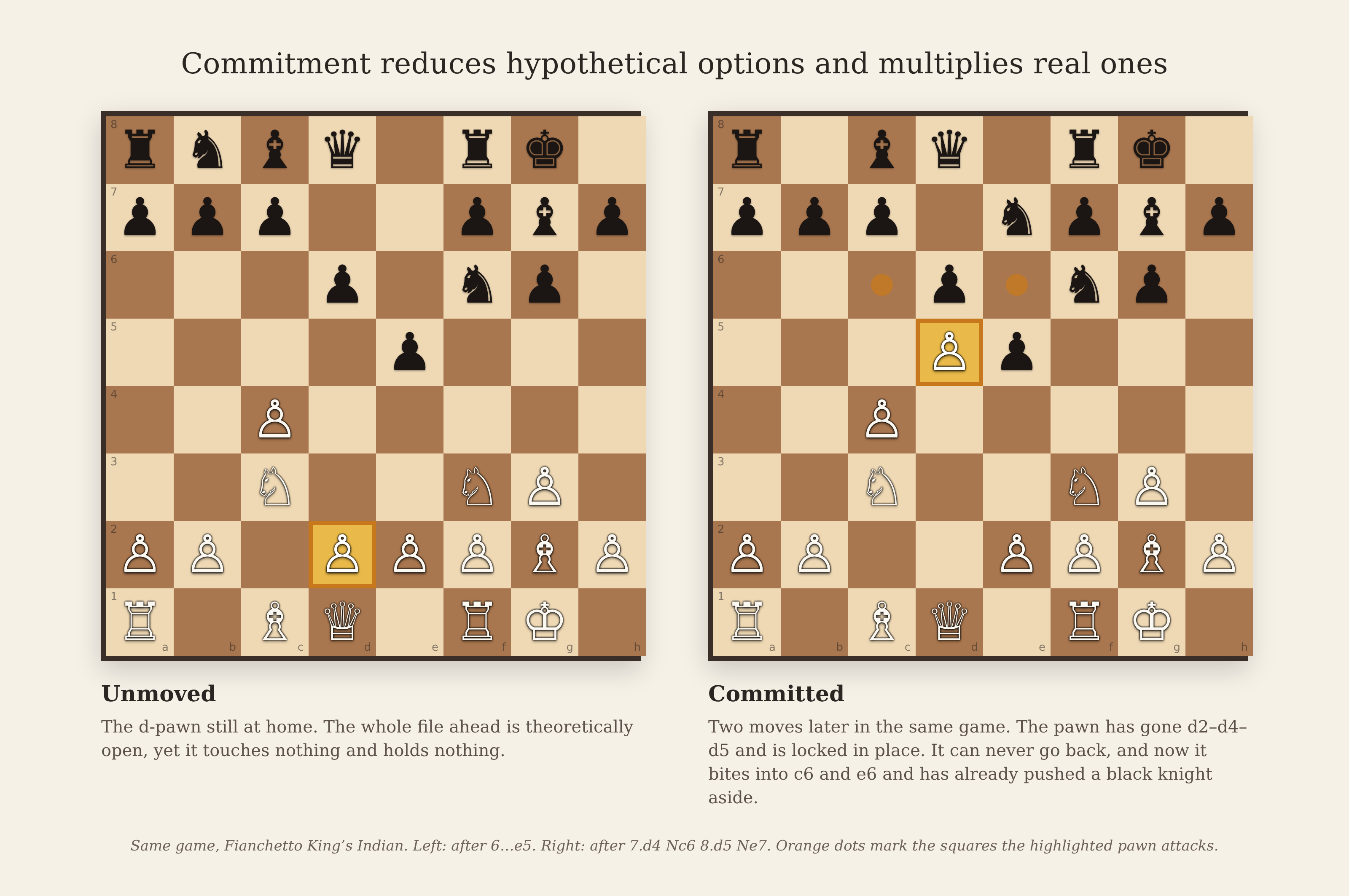
From community service to running a business to taking an active role in politics, all of these come with great responsibilities. But in them we can find great power: the power of optionality.
So here is the question this whole piece circles, and I would love to hear your answer. When in your life did you feel most free? And, looking back, how many real options did you actually have at that moment?
Notes
Nassim Nicholas Taleb, Antifragile: Things That Gain from Disorder (2012), Book IV.
David Graeber, Debt: The First 5,000 Years (2011). On the Sumerian ama(r)-gi and the Cone of Urukagina, see also Michael Hudson, “Modern (Mis)interpretations of Clean Slates.”
Code of Hammurabi, §117. Leviticus 25 on the Jubilee. On Solon’s seisachtheia, Aristotle, Constitution of the Athenians, chapter 6.
On the Tenth Penny and the Dutch Revolt, see Geoffrey Parker, The Dutch Revolt (1977).
Colonial tax burdens: Alvin Rabushka, Taxation in Colonial America (Princeton, 2008); Gary Walton & James Shepherd, The Economic Rise of Early America (1979). New York 2026 rates: New York State Department of Taxation and Finance; the 10.9 percent state rate applies above $25 million, the 3.876 percent city rate well below that. Combined with the 37 percent federal top rate, a high earner in Manhattan faces a marginal rate of roughly 52 percent on each additional dollar. The average New Yorker pays far less; the comparison is about the top of the scale.
Isaiah Berlin, “Two Concepts of Liberty” (1958); Amartya Sen, Development as Freedom (1999).
Network access deserves its own essay. Who will take your call, who will make an introduction, who will tell you the truth about a deal: these are options too, and they compound.
Viktor Frankl, Man’s Search for Meaning, from the 1984 postscript “The Case for a Tragic Optimism.” A Statue of Responsibility has been proposed several times since; none has been built.