

Everyone has a theory about why SpaceX & Tesla should merge. AI compute. Robots. Chips. One balance sheet. One place for Musk’s attention (although is that really an argument, given his track record?). Now that both companies have special committees formally studying it, the theories are multiplying.
The argument I rarely hear tied to the merger is the least glamorous one: telecom.
Where the merger stands
On October 20, Musk confirmed that SpaceX & Tesla have each formed a special committee of independent directors to study a merger. There is no agreement on terms. Most coverage expects an all-stock deal with SpaceX as the acquirer.
Starlink pays for the rockets
SpaceX is known for rockets, but rockets are not what pays the bills. Connectivity is. In 2025, Starlink & its sister services brought in $11.4 billion, 61 percent of SpaceX’s revenue. In the first nine months of this year they have already brought in $12.8 billion.
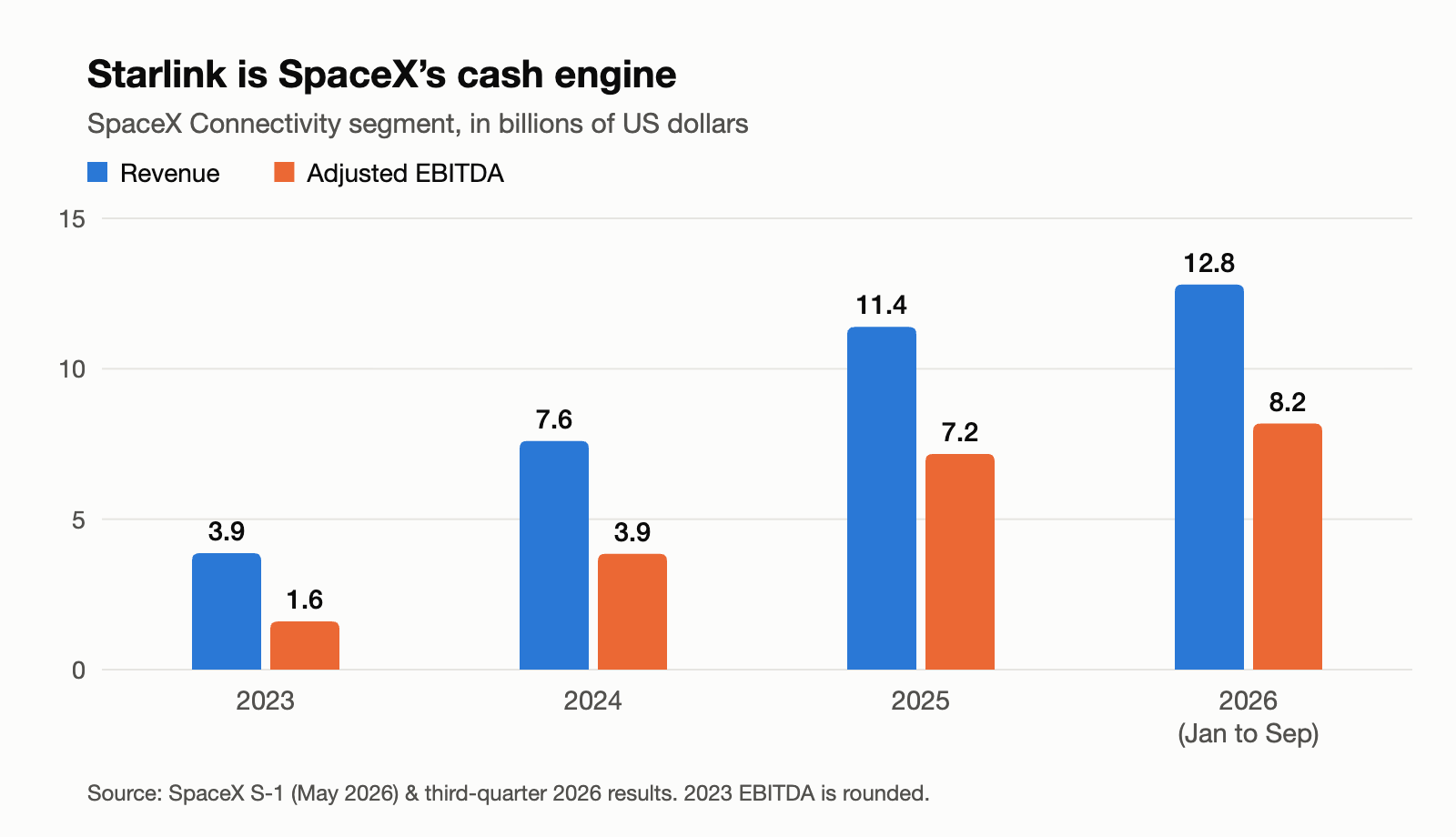
The profit picture is starker. Adjusted EBITDA is, roughly, what a business earns before interest, taxes & the wear on its equipment. In 2025 the Connectivity segment produced $7.2 billion of it, a 63 percent margin. SpaceX as a whole reported $6.6 billion. Starlink earned more than the entire company, because it was covering the losses everywhere else. Starship & the AI buildout are, in effect, paid for by internet subscriptions.
Last quarter the AI arm passed Starlink in revenue for the first time, helped by compute rental & the Cursor acquisition. Starlink is still the business with 13.6 million subscribers & a margin most telecom executives would not believe.
From a tweet to a carrier
So when Musk talks about phones, I pay attention. In November 2022, a month after buying Twitter, he said that if Apple & Google ever pulled the app from their stores, he would make an alternative phone. Most people read it as a throwaway line. I remember thinking that a man with thousands of satellites overhead was in an unusually strong position to become a carrier, and I do not recall hearing anyone else say so at the time.
Four years later it is no longer a thought experiment. Starlink Mobile already reaches 22 million monthly users through partner carriers, SpaceX has spent more than $17 billion on spectrum, and on the last earnings call Gwynne Shotwell said the service could “become a major mobile carrier in the U.S.”
Why satellites need the ground
There is a catch. A satellite beam covers an area miles wide, and everyone inside it shares the same capacity. In open country that works. In a city it does not.
Why space is not enough
One analyst model estimates that even next-generation satellites run out of capacity at around 82 people per square kilometer. Below that line sits 91 percent of America’s populated land, but only 23 percent of Americans. The other 77 percent live where a network needs radios on the ground.
SpaceX knows this. On its first earnings call as a public company, in August, Shotwell said it intends to build the terrestrial part too. It has since picked Qualcomm to supply base stations for tens of thousands of sites starting in 2027, and it is reportedly negotiating with tower owners for access to about 80,000 sites.
This is where Tesla comes in
Tesla runs about 3,100 Supercharger stations in the United States, with close to 38,000 stalls. Every one of them already has what a cell site needs & what takes a carrier years to assemble: land, a lease, a heavy grid connection, and a location chosen because people pass through it.
And a cell site does not have to be a 200-foot tower. SpaceX has described small radios that sit alongside a Starlink dish, with the satellite link carrying the traffic back to the network. No tower company in the middle. No fiber trench. Put one on a Supercharger and you have a working cell site. I am not the first to notice: reports on SpaceX’s plan already list Superchargers among the possible hosts. What I have not seen is anyone connecting it to the merger.
Is 3,100 a lot? Next to the 80,000 sites SpaceX is shopping for, no. But when Dish built America’s newest national network, it took about 15,000 sites to reach 70 percent of the population. Superchargers alone would be a fifth of that, on sites Tesla already controls. That is a head start no other challenger has had.
How far do 3,100 sites go?
A small cell reaches somewhere between 200 meters & 2 kilometers, depending on power, frequency & height (one informal estimate). Each Supercharger would serve its own neighborhood, not a whole town.
Satellites fill in the coverage between sites. What they cannot add is capacity where people cluster. The same analyst model puts the need at roughly 27,000 tower sites for the dense cities, plus millions of small radios across the suburbs, about one for every eight households.
So Superchargers would be a real slice of a challenger’s network & a thin slice of a Verizon-sized one. Their value is that they are powered, already built & controlled by a sister company.
Then there are the cars
The stations stand still. The cars do not, and this is the part I find most interesting.
Tesla has confirmed that the Cybercab will be its first vehicle with Starlink built in, and it has filed a patent for a roof that lets satellite signals pass through. Today, Teslas in the US get online through AT&T. A merged company would simply move its own fleet onto its own network: millions of lines on day one, and a data bill that stays in the family.
Now take it one step further. A car with a satellite link & a small radio is a cell site on wheels. This is speculation on my part, and others have floated it too: nobody at either company has announced it, and handing a call from one moving cell to the next is a hard engineering problem. But think about where a robotaxi fleet spends its day. Downtown at rush hour. The airport. The stadium on game night. It goes where the people are, which is exactly where a network runs short.
Why it takes a merger
None of this strictly requires a merger. Tesla could rent its sites to SpaceX tomorrow, and the two already trade: Tesla booked $405 million of battery sales to SpaceX in the first half of this year. But they are two public companies with different shareholders & the same CEO. Every site lease, every radio in a car roof, is a related-party deal that has to be negotiated at arm’s length & defended to two boards. Inside one company it is just a rollout plan.
And we have seen how fast Musk’s companies execute a rollout plan. xAI stood up its Colossus supercomputer in 122 days. Nvidia’s Jensen Huang has put the normal timeline for a data center at around four years. With the land, the power & the fleet already in place, I would not be surprised to see thousands of these sites go live within months of a green light.
What I would watch
I would not want to be Verizon, AT&T or T-Mobile watching this. Not because a new carrier appears overnight. Service is not due until the end of 2027, and SpaceX still holds far less spectrum than any of them. But it is the first challenger in decades that owns its own sky, and after a merger it would own a good piece of the ground & a fleet that moves across it.
Investors have noticed. When SpaceX announced a deal for low-band spectrum on October 8, all three carriers fell about 7 percent before the market even opened. By the close, T-Mobile was down 13 percent and AT&T & Verizon about 10. CNBC called it AT&T’s worst day since 2000. And that was before the merger committees were announced.
Am I missing something? I would love to hear from people who build networks for a living.